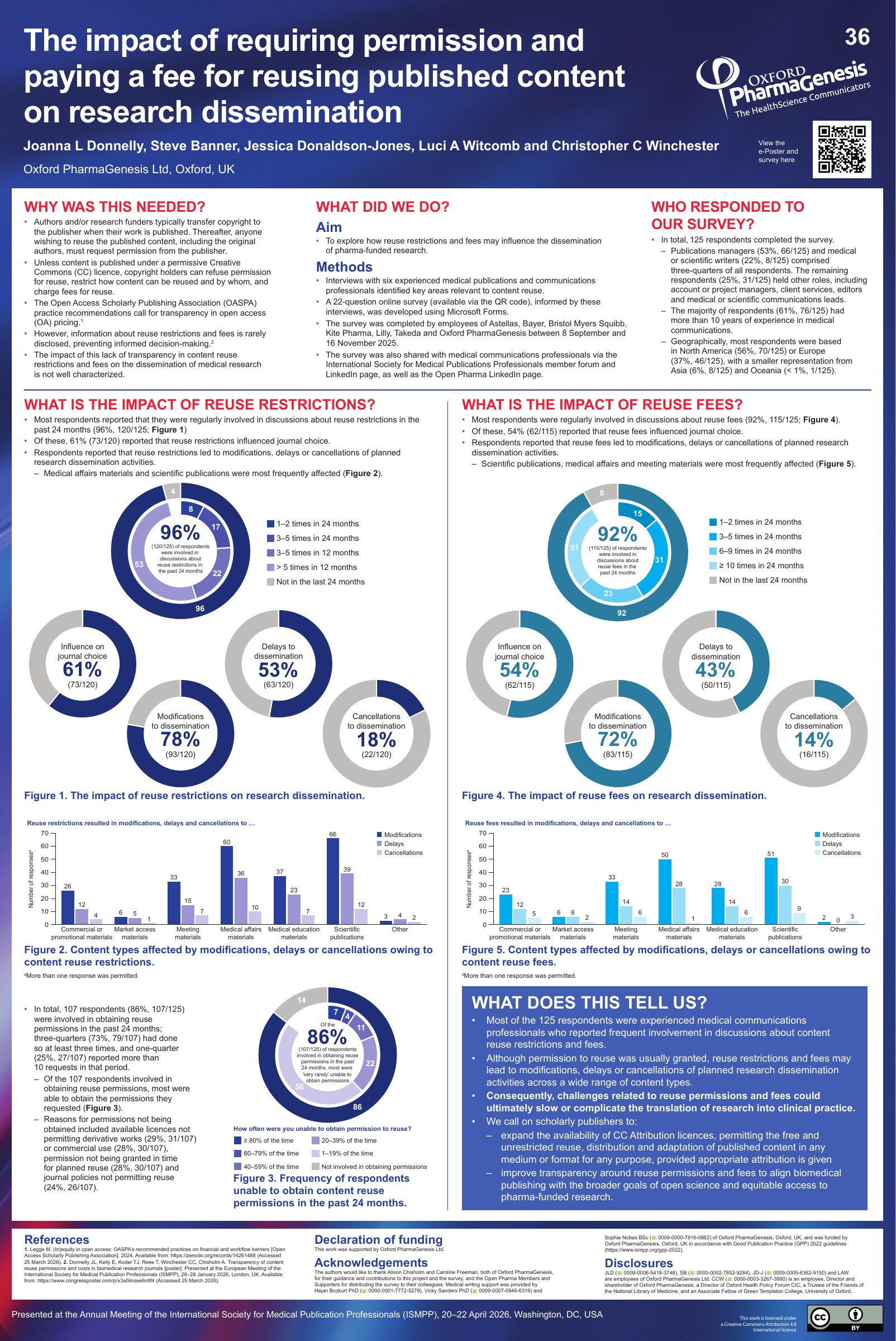
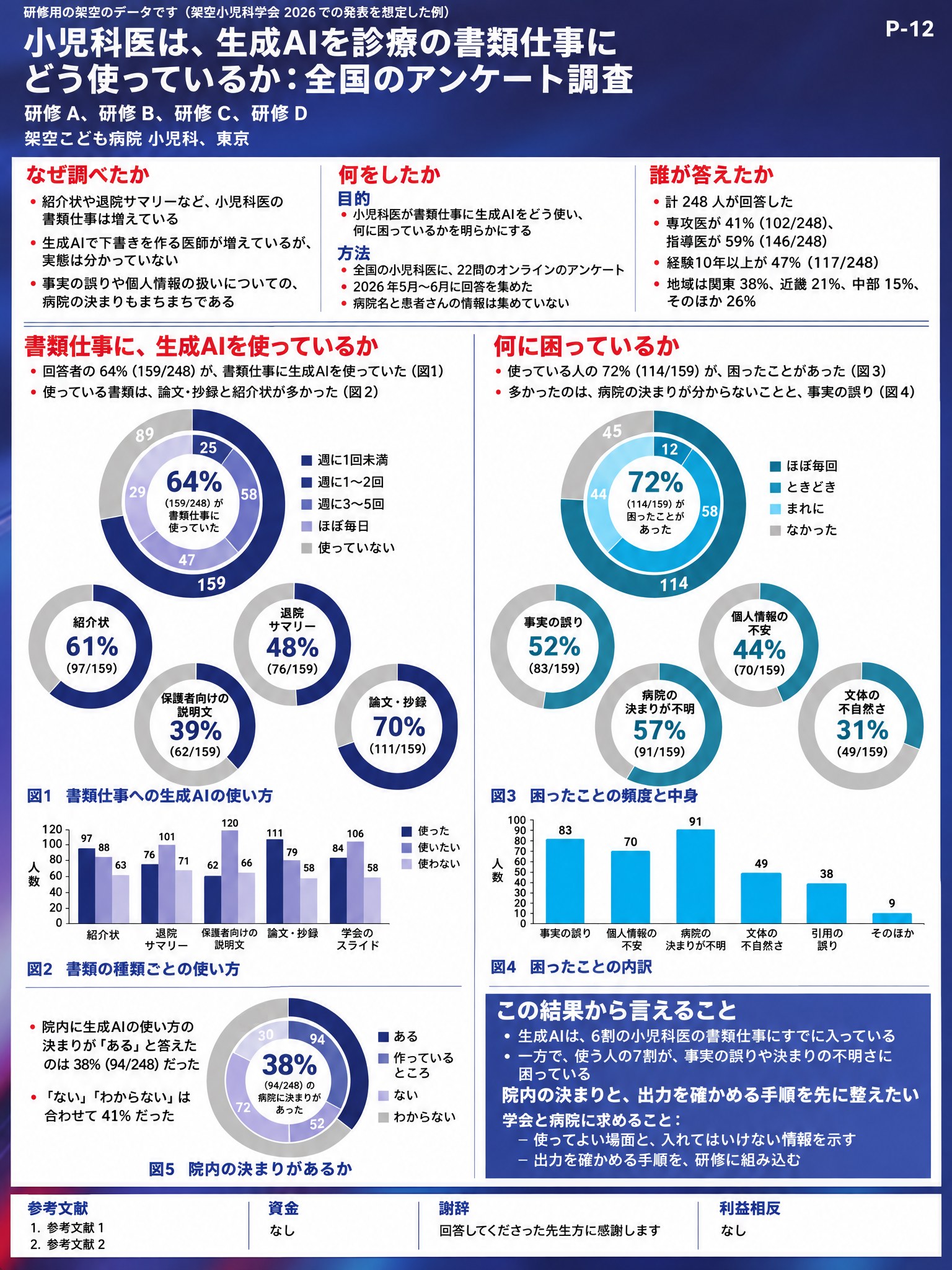
国際学会のポスター(英語)
頼んだこと製薬会社が米国の循環器の学会で出したポスターを型に、架空の小児喘息の研究の中身(表・色分けの格子・森林図2つ・研究の流れ図)を全部英語で書いて1回で。字と数は全部、頼んだとおりに入った
頼んだ文を見る
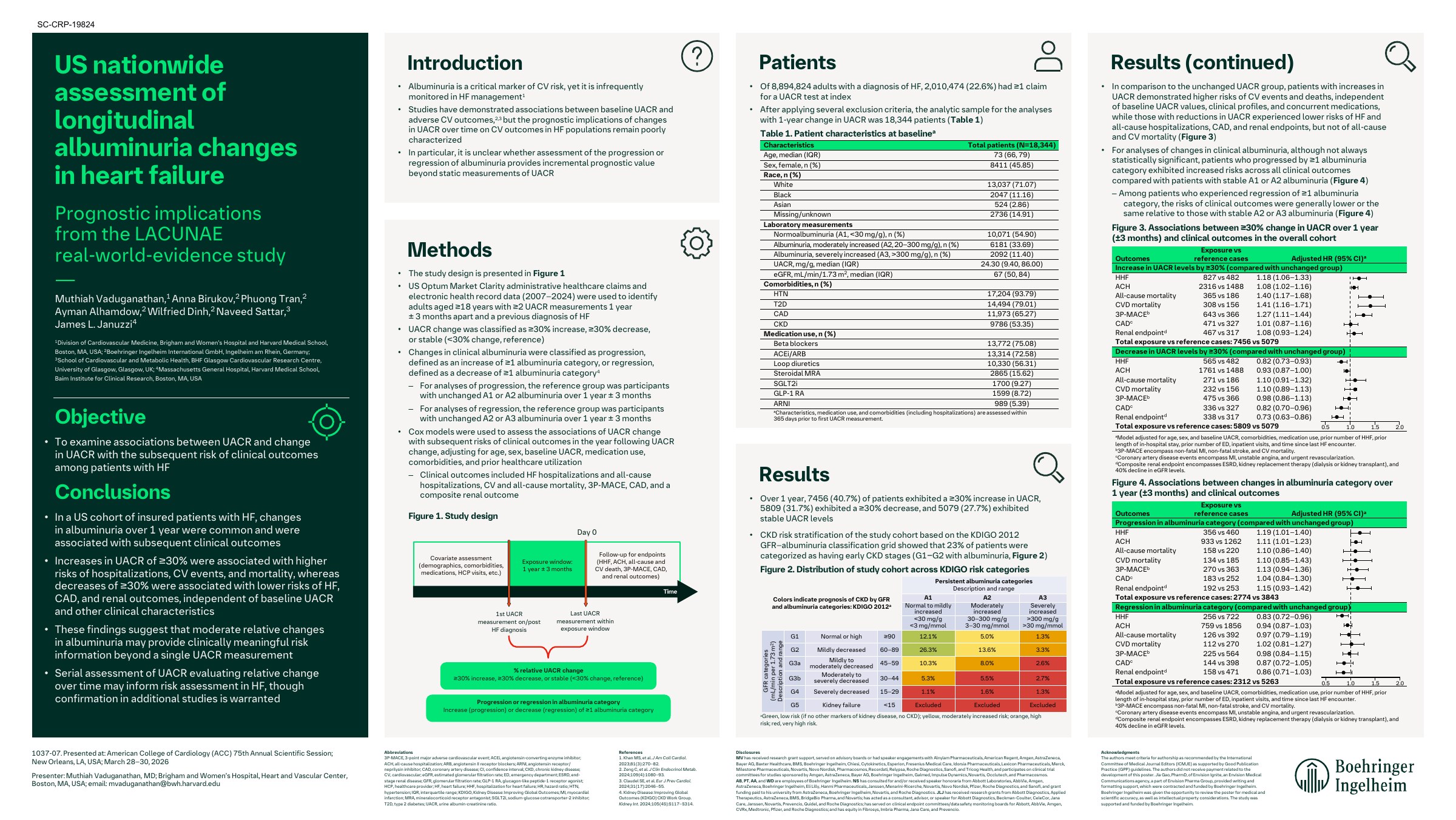
Use the attached conference poster as an exact template. Reproduce its layout, grid, proportions, typography and colour system faithfully, at the same density of small text: a light warm-grey background; a tall dark green panel on the left holding a large bright-green bold title, a lighter green subtitle, a short green rule, the author line with superscript numbers and small affiliations, then "Objective" with a target icon and "Conclusions" with bullets in white; bottom-left small presentation note in two lines. To the right, four light grey cards in two columns, each with a large bold black heading and a thin-line icon at the top right (question mark circle, gear, person, magnifying glass): "Introduction" and "Methods" (with the Figure 1 study-design timeline with a black arrow, a bright green exposure window, two red down-arrows, a red brace, and two bright-green rounded boxes) in the first column; "Patients" (with Table 1 with a bright green header row) and "Results" (with Figure 2, a colour-graded risk grid in green, yellow, orange and red) in the second column; and "Results (continued)" on the far right with two forest-plot tables (Figure 3 and Figure 4) with bright green header rows, point estimates with error bars and a dashed vertical line at 1.0, axis 0.5 to 2.0. Tiny Abbreviations, References, Disclosures and Acknowledgments blocks along the bottom. Same fonts (a clean geometric sans-serif), same weights, same line spacing.
Remove the company logo at the bottom right (leave the space empty) and remove the small code at the top left.

Replace all content with exactly this text:
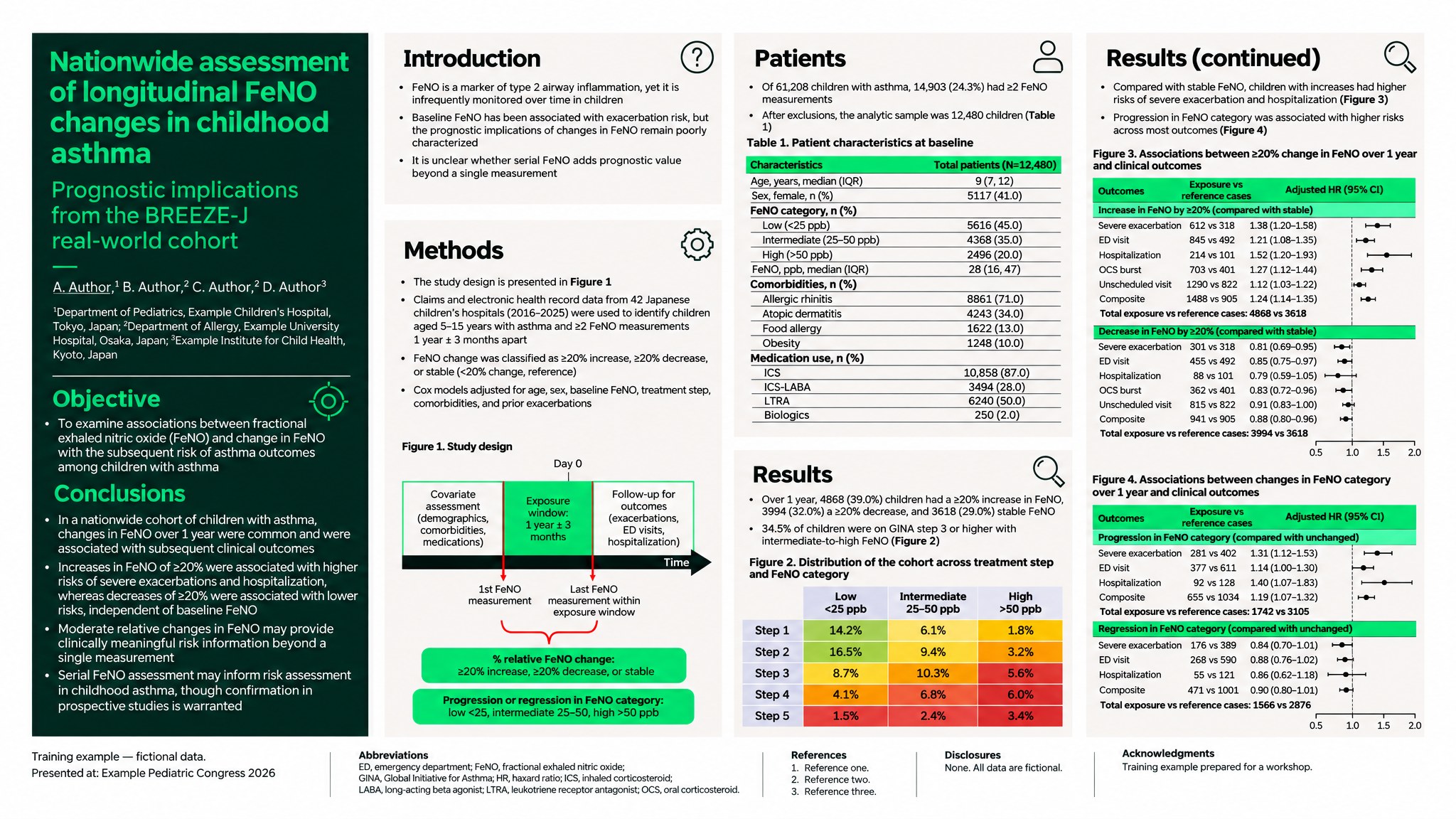
Title: "Nationwide assessment of longitudinal FeNO changes in childhood asthma"
Subtitle: "Prognostic implications from the BREEZE-J real-world cohort"
Authors: "A. Author,1 B. Author,2 C. Author,2 D. Author3"
Affiliations: "1Department of Pediatrics, Example Children's Hospital, Tokyo, Japan; 2Department of Allergy, Example University Hospital, Osaka, Japan; 3Example Institute for Child Health, Kyoto, Japan"
Objective: "To examine associations between fractional exhaled nitric oxide (FeNO) and change in FeNO with the subsequent risk of asthma outcomes among children with asthma"
Conclusions (4 bullets): "In a nationwide cohort of children with asthma, changes in FeNO over 1 year were common and were associated with subsequent clinical outcomes" / "Increases in FeNO of ≥20% were associated with higher risks of severe exacerbations and hospitalization, whereas decreases of ≥20% were associated with lower risks, independent of baseline FeNO" / "Moderate relative changes in FeNO may provide clinically meaningful risk information beyond a single measurement" / "Serial FeNO assessment may inform risk assessment in childhood asthma, though confirmation in prospective studies is warranted"
Bottom-left note: "Training example — fictional data." and "Presented at: Example Pediatric Congress 2026"
Introduction (3 bullets): "FeNO is a marker of type 2 airway inflammation, yet it is infrequently monitored over time in children" / "Baseline FeNO has been associated with exacerbation risk, but the prognostic implications of changes in FeNO remain poorly characterized" / "It is unclear whether serial FeNO adds prognostic value beyond a single measurement"
Methods (bullets): "The study design is presented in Figure 1" / "Claims and electronic health record data from 42 Japanese children's hospitals (2016–2025) were used to identify children aged 5–15 years with asthma and ≥2 FeNO measurements 1 year ± 3 months apart" / "FeNO change was classified as ≥20% increase, ≥20% decrease, or stable (<20% change, reference)" / "Cox models adjusted for age, sex, baseline FeNO, treatment step, comorbidities, and prior exacerbations"
Figure 1 title: "Figure 1. Study design". Timeline boxes: "Covariate assessment (demographics, comorbidities, medications)", "Exposure window: 1 year ± 3 months", "Follow-up for outcomes (exacerbations, ED visits, hospitalization)", label "Day 0", arrow label "Time", below arrows "1st FeNO measurement" and "Last FeNO measurement within exposure window". Green boxes: "% relative FeNO change: ≥20% increase, ≥20% decrease, or stable" and "Progression or regression in FeNO category: low <25, intermediate 25–50, high >50 ppb".
Patients (bullets): "Of 61,208 children with asthma, 14,903 (24.3%) had ≥2 FeNO measurements" / "After exclusions, the analytic sample was 12,480 children (Table 1)"
Table 1 title: "Table 1. Patient characteristics at baseline". Header: "Characteristics" | "Total patients (N=12,480)". Rows: "Age, years, median (IQR)" "9 (7, 12)"; "Sex, female, n (%)" "5117 (41.0)"; section "FeNO category, n (%)"; "Low (<25 ppb)" "5616 (45.0)"; "Intermediate (25–50 ppb)" "4368 (35.0)"; "High (>50 ppb)" "2496 (20.0)"; "FeNO, ppb, median (IQR)" "28 (16, 47)"; section "Comorbidities, n (%)"; "Allergic rhinitis" "8861 (71.0)"; "Atopic dermatitis" "4243 (34.0)"; "Food allergy" "1622 (13.0)"; "Obesity" "1248 (10.0)"; section "Medication use, n (%)"; "ICS" "10,858 (87.0)"; "ICS-LABA" "3494 (28.0)"; "LTRA" "6240 (50.0)"; "Biologics" "250 (2.0)".
Results (bullets): "Over 1 year, 4868 (39.0%) children had a ≥20% increase in FeNO, 3994 (32.0%) a ≥20% decrease, and 3618 (29.0%) stable FeNO" / "34.5% of children were on GINA step 3 or higher with intermediate-to-high FeNO (Figure 2)"
Figure 2 title: "Figure 2. Distribution of the cohort across treatment step and FeNO category". Columns "Low <25 ppb", "Intermediate 25–50 ppb", "High >50 ppb"; rows "Step 1" 14.2%, 6.1%, 1.8%; "Step 2" 16.5%, 9.4%, 3.2%; "Step 3" 8.7%, 10.3%, 5.6%; "Step 4" 4.1%, 6.8%, 6.0%; "Step 5" 1.5%, 2.4%, 3.4%. Colours from green (low risk, top left) to red (high risk, bottom right).
Results (continued) bullets: "Compared with stable FeNO, children with increases had higher risks of severe exacerbation and hospitalization (Figure 3)" / "Progression in FeNO category was associated with higher risks across most outcomes (Figure 4)"
Figure 3 title: "Figure 3. Associations between ≥20% change in FeNO over 1 year and clinical outcomes". Header "Outcomes" | "Exposure vs reference cases" | "Adjusted HR (95% CI)". Section "Increase in FeNO by ≥20% (compared with stable)": "Severe exacerbation" "612 vs 318" "1.38 (1.20–1.58)"; "ED visit" "845 vs 492" "1.21 (1.08–1.35)"; "Hospitalization" "214 vs 101" "1.52 (1.20–1.93)"; "OCS burst" "703 vs 401" "1.27 (1.12–1.44)"; "Unscheduled visit" "1290 vs 822" "1.12 (1.03–1.22)"; "Composite" "1488 vs 905" "1.24 (1.14–1.35)"; "Total exposure vs reference cases: 4868 vs 3618". Section "Decrease in FeNO by ≥20% (compared with stable)": "Severe exacerbation" "301 vs 318" "0.81 (0.69–0.95)"; "ED visit" "455 vs 492" "0.85 (0.75–0.97)"; "Hospitalization" "88 vs 101" "0.79 (0.59–1.05)"; "OCS burst" "362 vs 401" "0.83 (0.72–0.96)"; "Unscheduled visit" "815 vs 822" "0.91 (0.83–1.00)"; "Composite" "941 vs 905" "0.88 (0.80–0.96)"; "Total exposure vs reference cases: 3994 vs 3618".
Figure 4 title: "Figure 4. Associations between changes in FeNO category over 1 year and clinical outcomes". Same columns. Section "Progression in FeNO category (compared with unchanged)": "Severe exacerbation" "281 vs 402" "1.31 (1.12–1.53)"; "ED visit" "377 vs 611" "1.14 (1.00–1.30)"; "Hospitalization" "92 vs 128" "1.40 (1.07–1.83)"; "Composite" "655 vs 1034" "1.19 (1.07–1.32)"; "Total exposure vs reference cases: 1742 vs 3105". Section "Regression in FeNO category (compared with unchanged)": "Severe exacerbation" "176 vs 389" "0.84 (0.70–1.01)"; "ED visit" "268 vs 590" "0.88 (0.76–1.02)"; "Hospitalization" "55 vs 121" "0.86 (0.62–1.18)"; "Composite" "471 vs 1001" "0.90 (0.80–1.01)"; "Total exposure vs reference cases: 1566 vs 2876".
Draw each forest-plot point at its HR on the 0.5–2.0 axis with whiskers spanning the 95% CI.
Bottom small blocks: "Abbreviations" with a short line of abbreviations (ED, emergency department; FeNO, fractional exhaled nitric oxide; GINA, Global Initiative for Asthma; HR, hazard ratio; ICS, inhaled corticosteroid; LABA, long-acting beta agonist; LTRA, leukotriene receptor antagonist; OCS, oral corticosteroid); "References" with "1. Reference one." "2. Reference two." "3. Reference three."; "Disclosures" with "None. All data are fictional."; "Acknowledgments" with "Training example prepared for a workshop."

Do not keep any of the template's original words, names, numbers, logos or codes. All digits half-width.