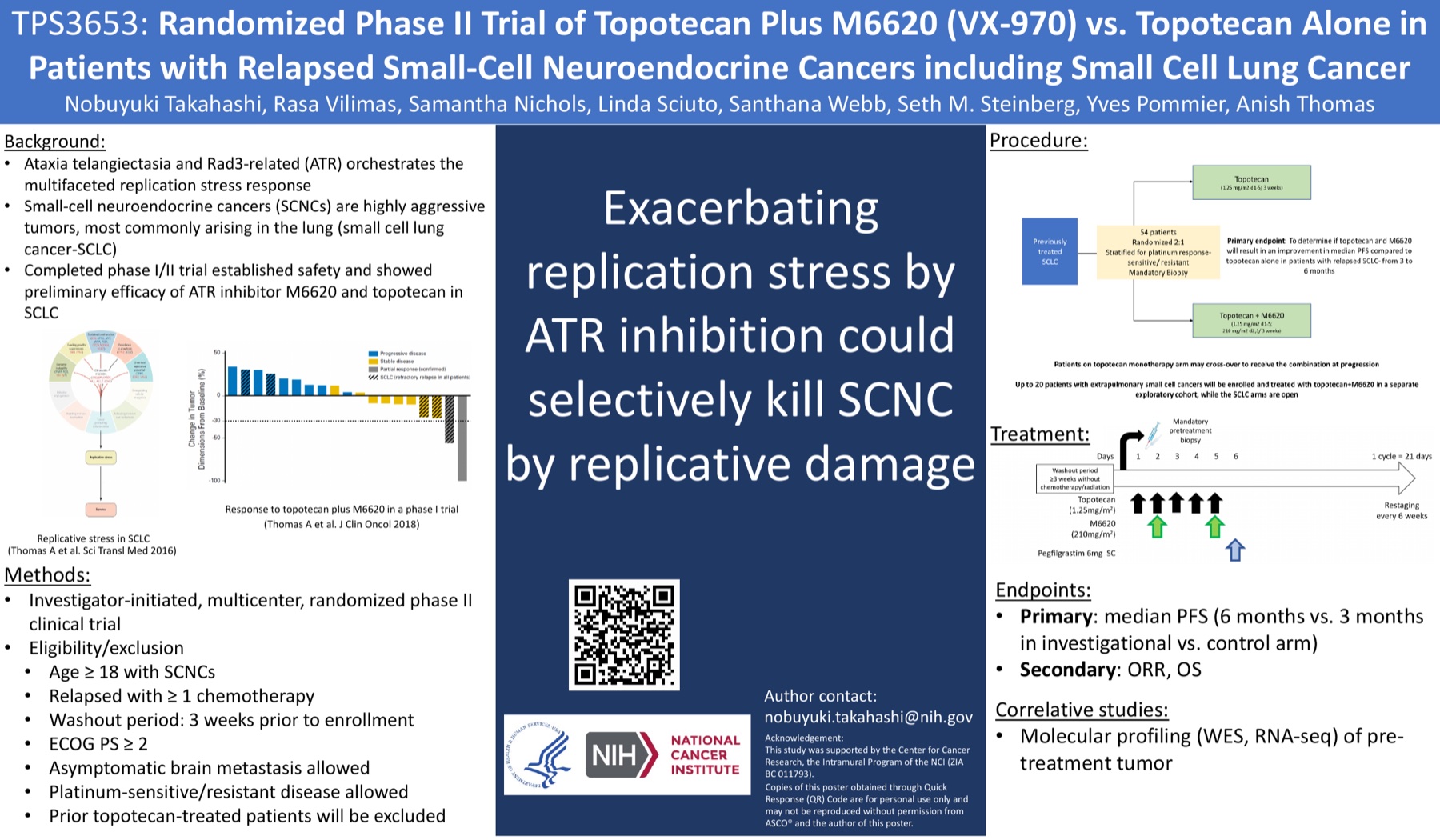
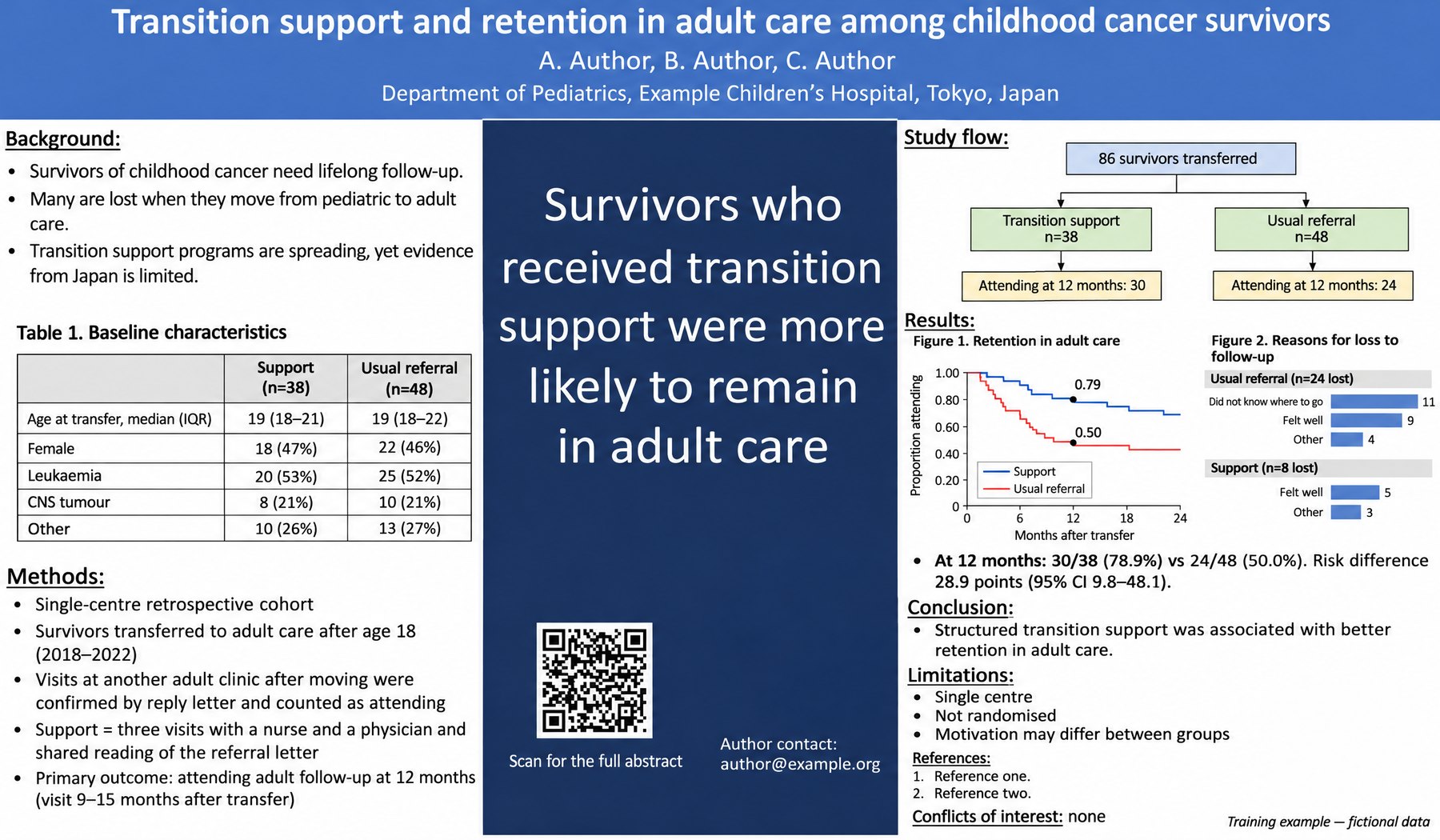
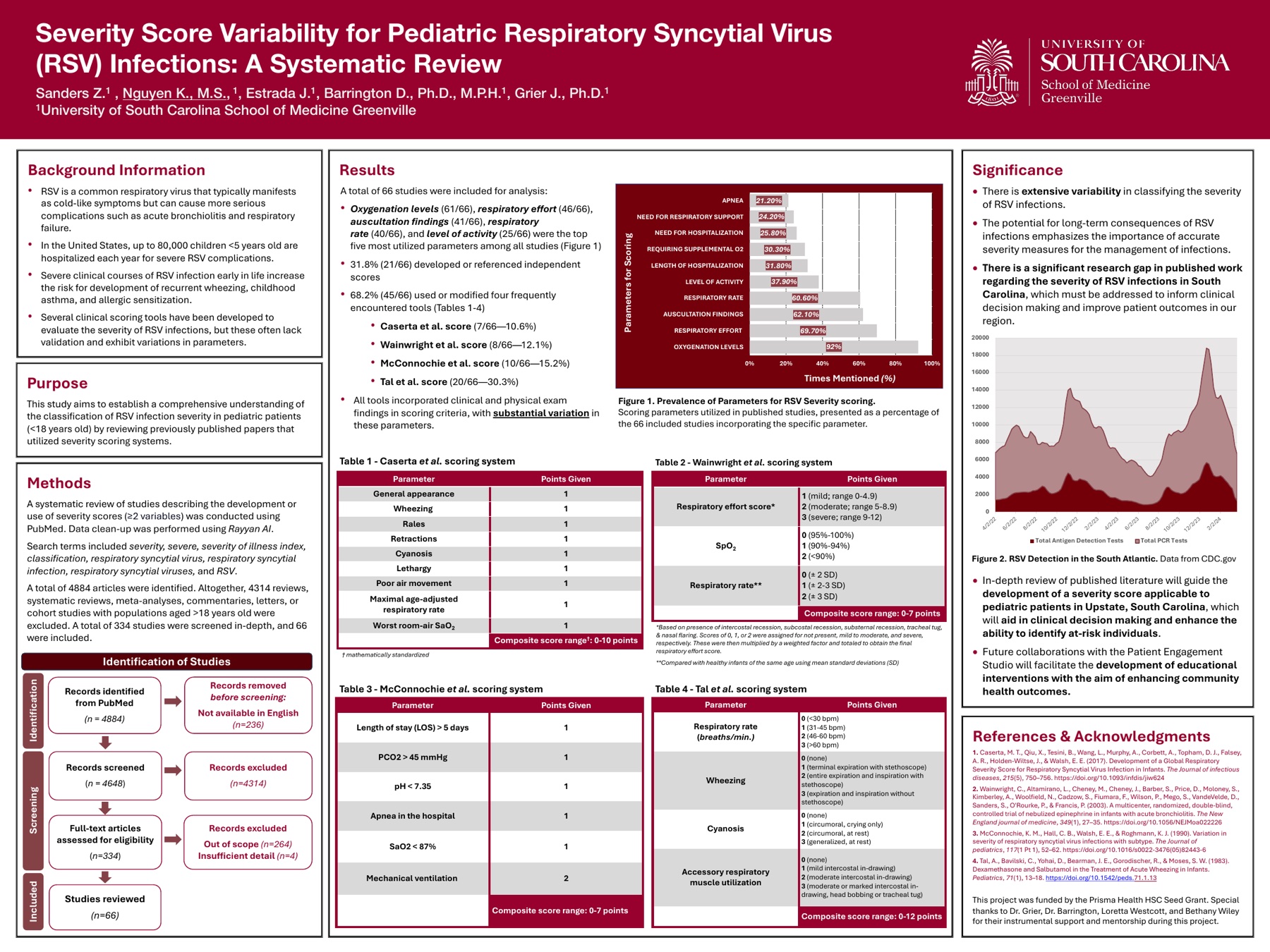
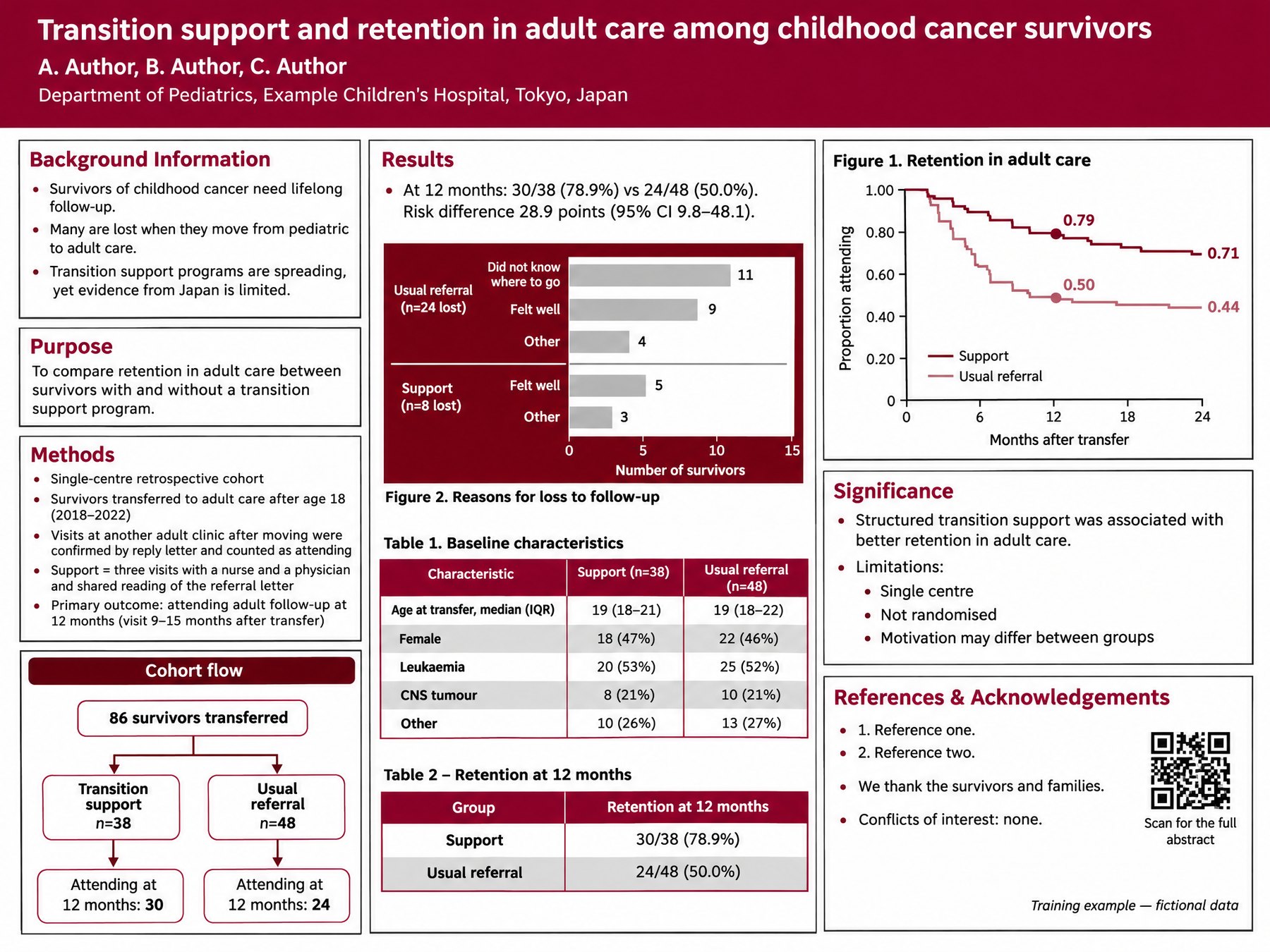
紺地に見出しの帯(図表が多い型)
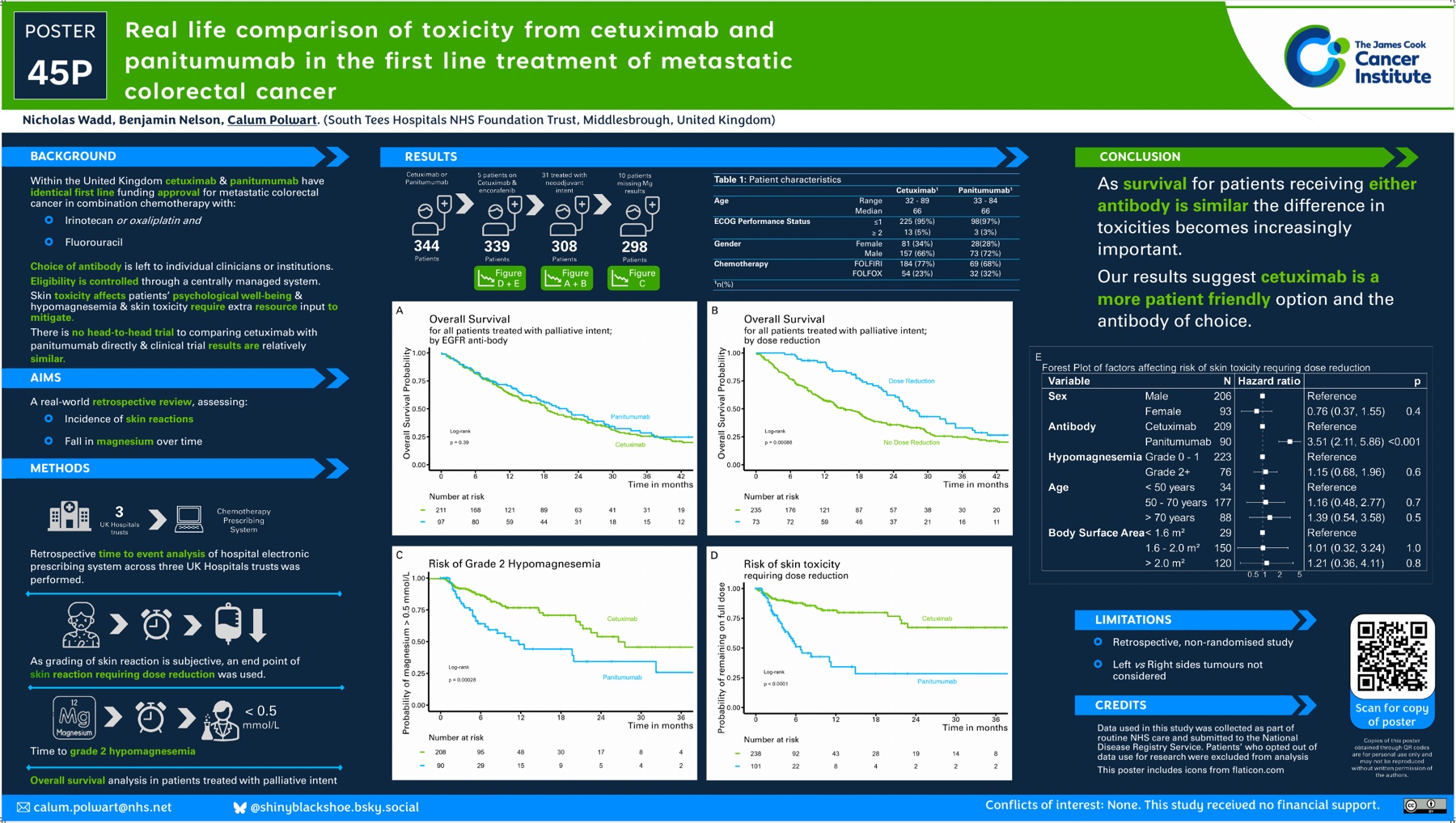
頼んだこと実際の学会ポスターを手本に渡し、見出しの帯・段組み・小さな文字・表・曲線の描き方を写したまま、題・著者・本文・表・図の中身を全部指定した。ロゴは描かないと書いた
頼んだ文を見る
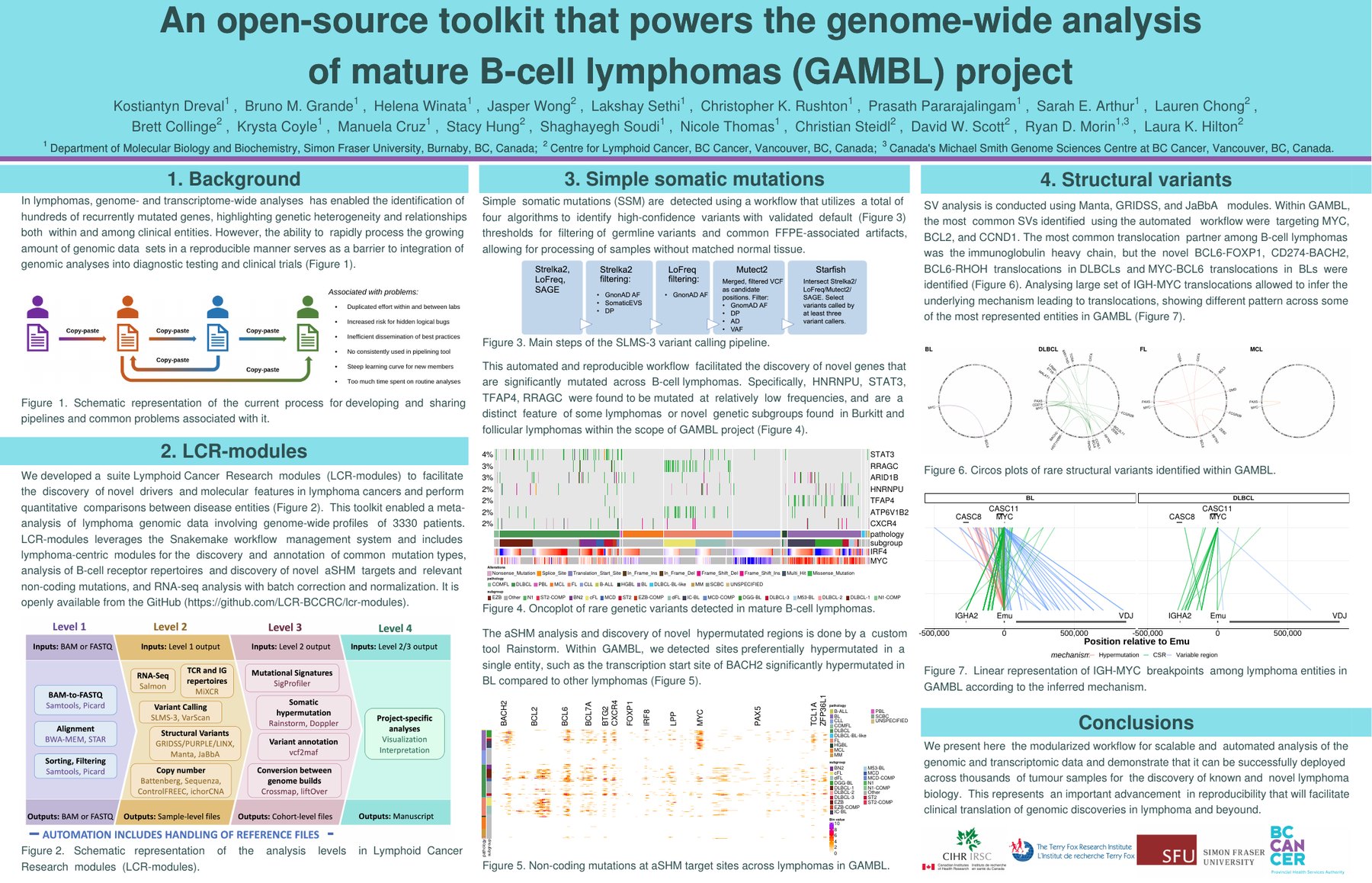
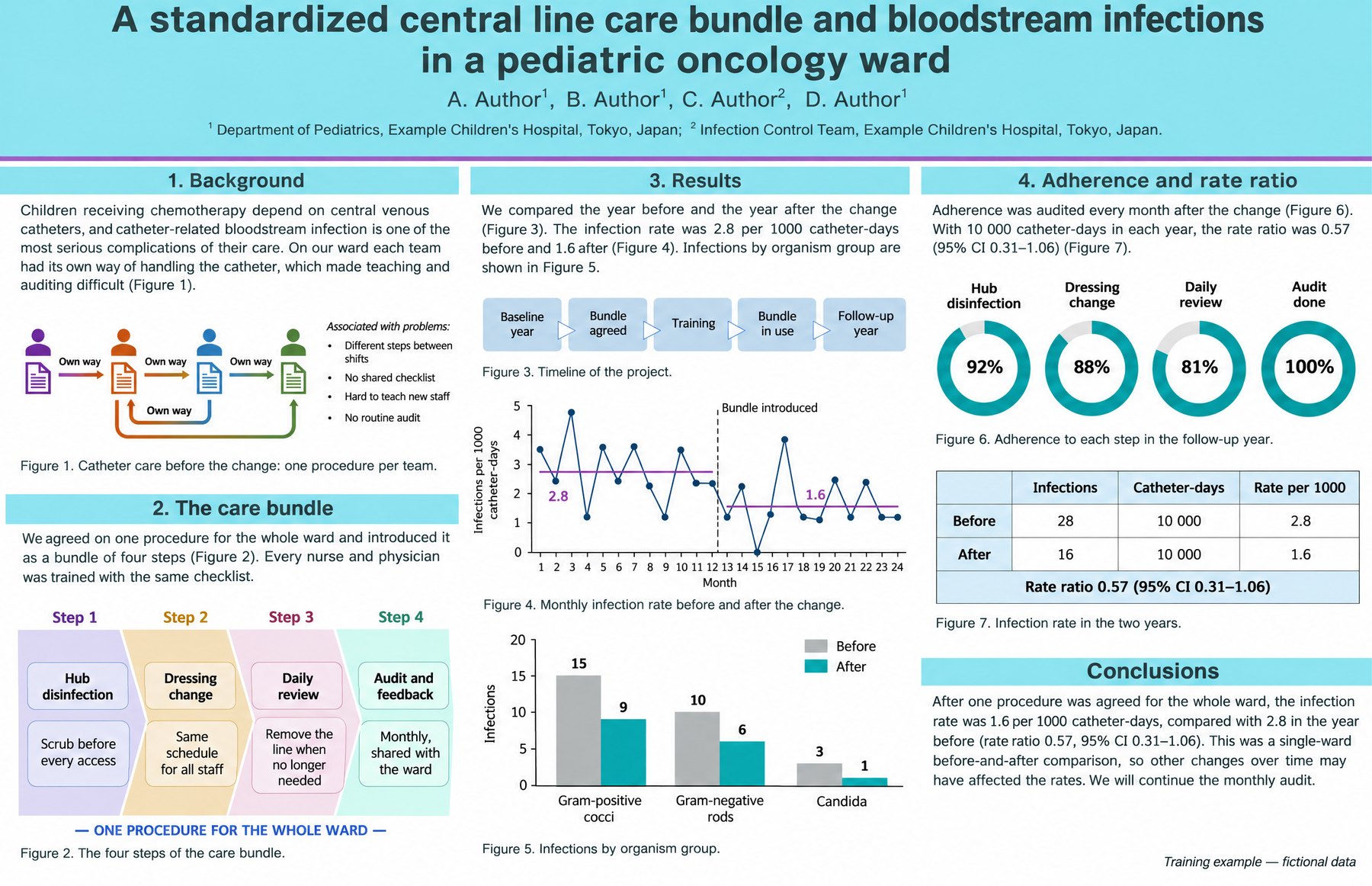
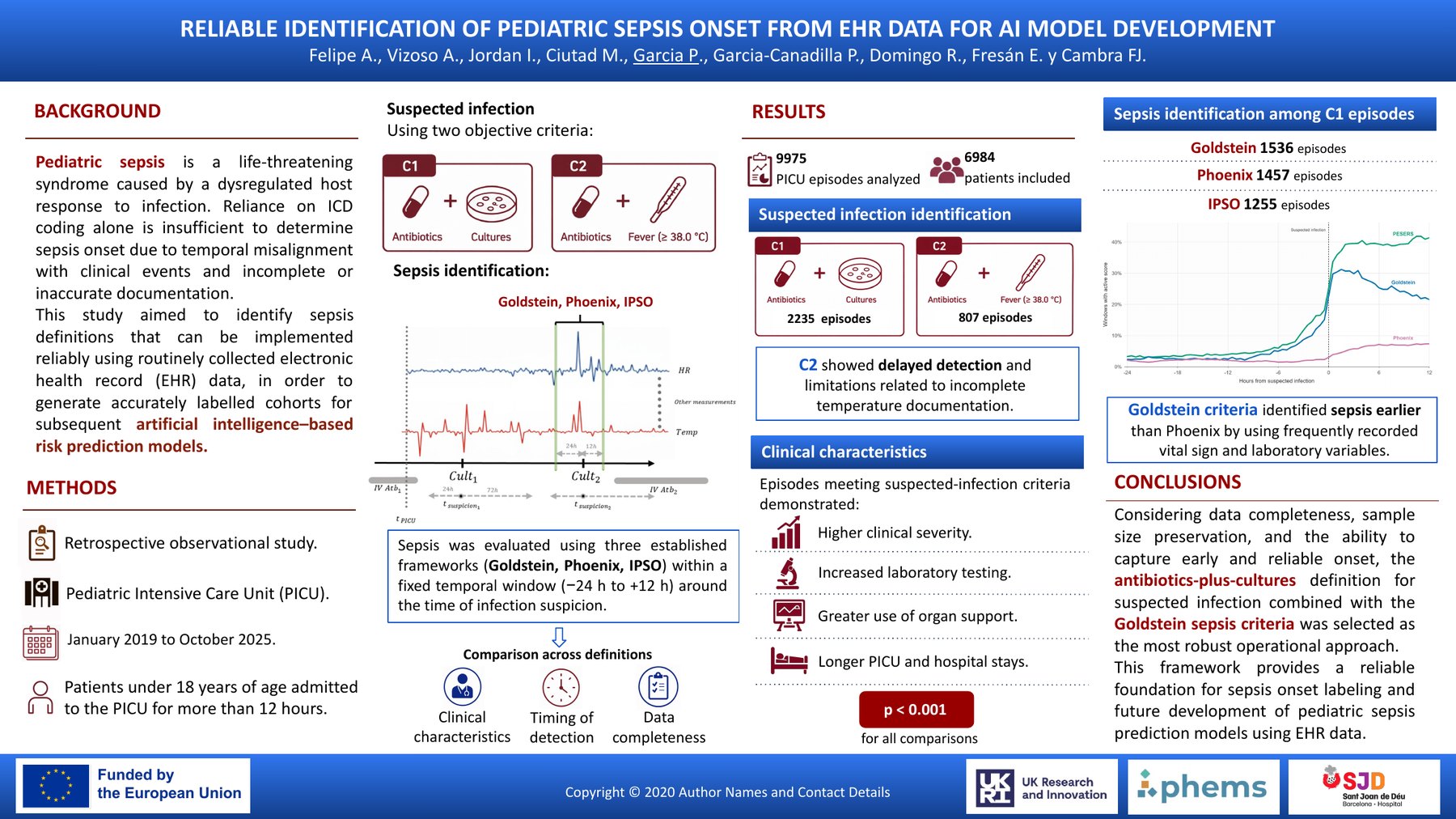
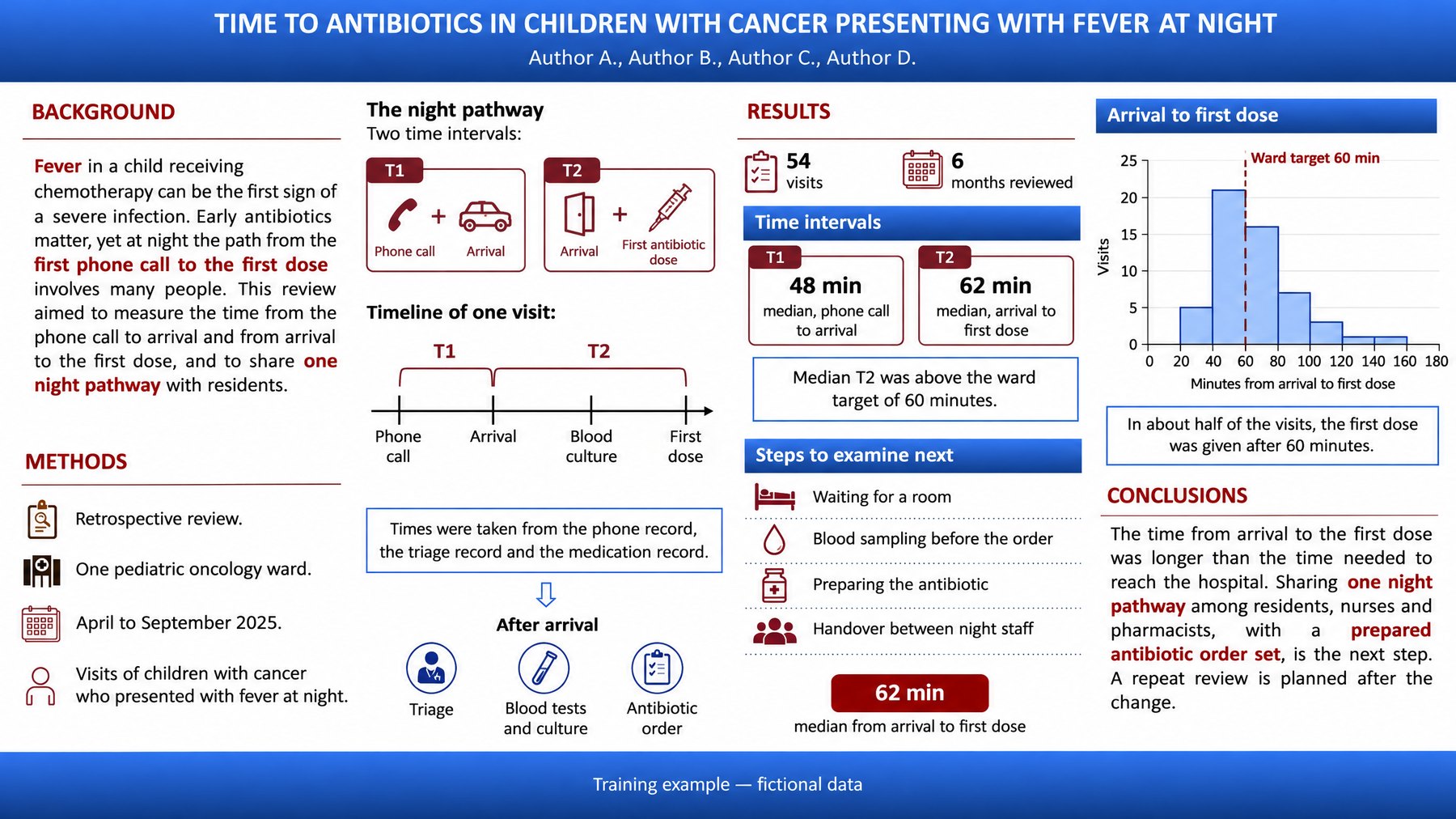
Use the attached conference poster as an exact template. Keep the identical layout, columns, section header shapes, colors (navy body, bright header band), font family, small font sizes, text density, icon style, table style, and the style of the survival-curve figures (fine step lines, axis labels, panel letters, small legends and p-value labels). Remove both logos and do not draw any logo. Draw no censoring marks (no '+' and no tick marks) on any curve: no survivor was censored before 24 months.
Replace the content as follows (keep the same amount of text and figures as the template):
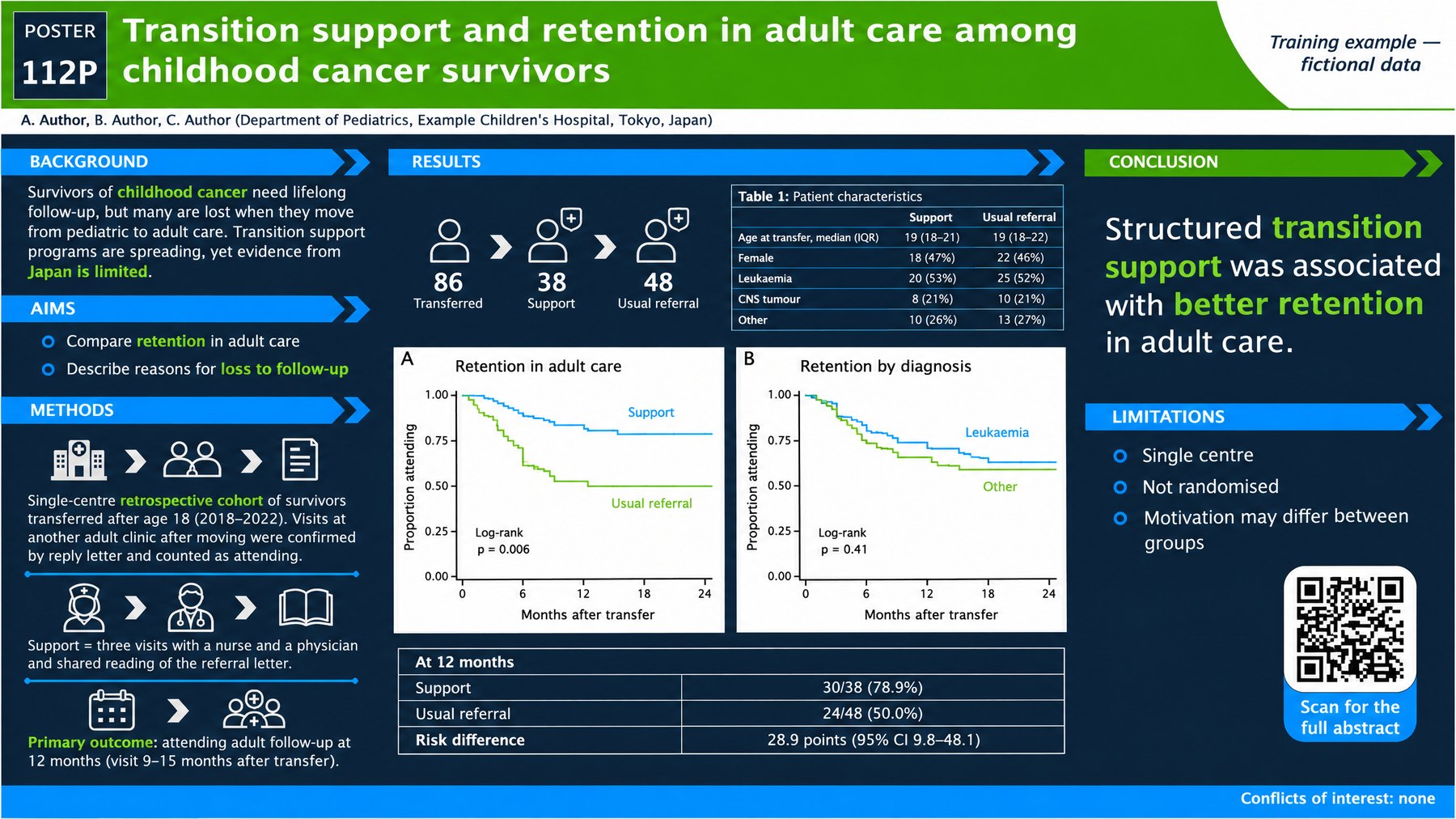
Poster number box: "POSTER 112P". Title: "Transition support and retention in adult care among childhood cancer survivors". Author line: "A. Author, B. Author, C. Author (Department of Pediatrics, Example Children's Hospital, Tokyo, Japan)".
BACKGROUND: "Survivors of childhood cancer need lifelong follow-up, but many are lost when they move from pediatric to adult care. Transition support programs are spreading, yet evidence from Japan is limited."
AIMS: "Compare retention in adult care" and "Describe reasons for loss to follow-up" as two bullet points.
METHODS: "Single-centre retrospective cohort of survivors transferred after age 18 (2018–2022). Visits at another adult clinic after moving were confirmed by reply letter and counted as attending. Support = three visits with a nurse and a physician and shared reading of the referral letter. Primary outcome: attending adult follow-up at 12 months (visit 9–15 months after transfer)." with the icon row style of the template.
RESULTS: an icon flow like the template: "86" "Transferred" → "38" "Support" → "48" "Usual referral". Table 1 "Patient characteristics" with rows "Age at transfer, median (IQR)" "19 (18–21)" "19 (18–22)"; "Female" "18 (47%)" "22 (46%)"; "Leukaemia" "20 (53%)" "25 (52%)"; "CNS tumour" "8 (21%)" "10 (21%)"; "Other" "10 (26%)" "13 (27%)". Figure A "Retention in adult care" (two curves: "Support" and "Usual referral", y axis "Proportion attending" 0–1.00, x axis "Months after transfer" 0–24, "Log-rank p = 0.006"). Figure B "Retention by diagnosis" (curves "Leukaemia" and "Other", "Log-rank p = 0.41"). A small table "At 12 months" with "Support 30/38 (78.9%)" "Usual referral 24/48 (50.0%)" "Risk difference 28.9 points (95% CI 9.8–48.1)".
CONCLUSION (large text): "Structured transition support was associated with better retention in adult care." LIMITATIONS: "Single centre" "Not randomised" "Motivation may differ between groups" as bullets. Footer: "Conflicts of interest: none" and a QR code placeholder labelled "Scan for the full abstract".
In a small corner add exactly: "Training example — fictional data". Use only the quoted text for any new text. Do not keep any of the original words, names, logos, journal names, institution names or numbers from the template.